Back to resources
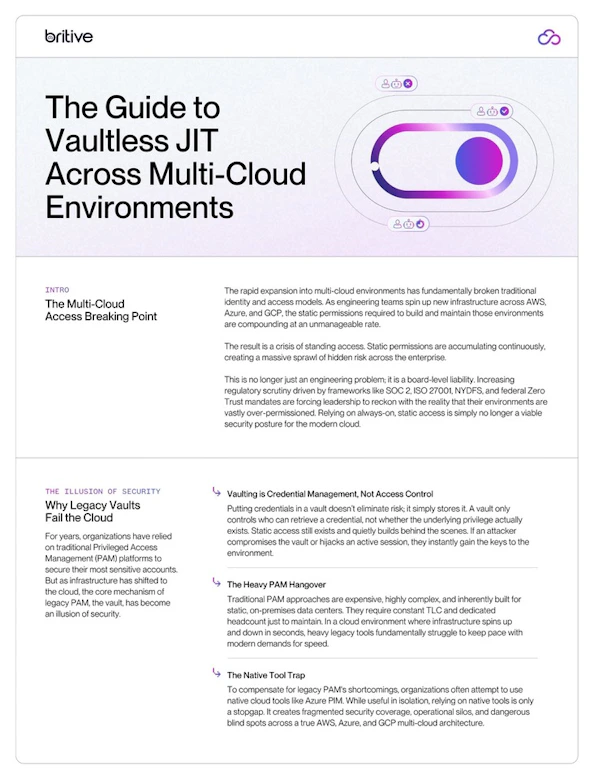
The Guide to Vaultless JIT Across Multi-Cloud Environments
A clear breakdown of why vault-based access falls short in multi-cloud environments — and what it actually takes to achieve Zero Standing Privileges across AWS, Azure, GCP, and every identity type running in your environment.
'/%3e%3cpath%20d='M5.42857%2016.2H10.8571V21.6H5.42857V16.2Z'%20fill='url(%23paint1_linear_1_1466)'/%3e%3cpath%20d='M10.8571%2021.6H16.2857V27H10.8571V21.6Z'%20fill='url(%23paint2_linear_1_1466)'/%3e%3cpath%20d='M16.2857%2016.2H21.7143V21.6H16.2857V16.2Z'%20fill='url(%23paint3_linear_1_1466)'/%3e%3cpath%20d='M21.7143%2010.8H27.1429V16.2H21.7143V10.8Z'%20fill='url(%23paint4_linear_1_1466)'/%3e%3cpath%20d='M27.1429%205.4H32.5714V10.8H27.1429V5.4Z'%20fill='url(%23paint5_linear_1_1466)'/%3e%3cpath%20d='M32.5714%200H38V5.4H32.5714V0Z'%20fill='url(%23paint6_linear_1_1466)'/%3e%3cdefs%3e%3clinearGradient%20id='paint0_linear_1_1466'%20x1='1.94872'%20y1='1.96154'%20x2='38.1177'%20y2='26.8387'%20gradientUnits='userSpaceOnUse'%3e%3cstop%20stop-color='%23CA1ECC'/%3e%3cstop%20offset='1'%20stop-color='%233E5DE0'/%3e%3c/linearGradient%3e%3clinearGradient%20id='paint1_linear_1_1466'%20x1='1.94872'%20y1='1.96154'%20x2='38.1177'%20y2='26.8387'%20gradientUnits='userSpaceOnUse'%3e%3cstop%20stop-color='%23CA1ECC'/%3e%3cstop%20offset='1'%20stop-color='%233E5DE0'/%3e%3c/linearGradient%3e%3clinearGradient%20id='paint2_linear_1_1466'%20x1='1.94872'%20y1='1.96154'%20x2='38.1177'%20y2='26.8387'%20gradientUnits='userSpaceOnUse'%3e%3cstop%20stop-color='%23CA1ECC'/%3e%3cstop%20offset='1'%20stop-color='%233E5DE0'/%3e%3c/linearGradient%3e%3clinearGradient%20id='paint3_linear_1_1466'%20x1='1.94872'%20y1='1.96154'%20x2='38.1177'%20y2='26.8387'%20gradientUnits='userSpaceOnUse'%3e%3cstop%20stop-color='%23CA1ECC'/%3e%3cstop%20offset='1'%20stop-color='%233E5DE0'/%3e%3c/linearGradient%3e%3clinearGradient%20id='paint4_linear_1_1466'%20x1='1.94872'%20y1='1.96154'%20x2='38.1177'%20y2='26.8387'%20gradientUnits='userSpaceOnUse'%3e%3cstop%20stop-color='%23CA1ECC'/%3e%3cstop%20offset='1'%20stop-color='%233E5DE0'/%3e%3c/linearGradient%3e%3clinearGradient%20id='paint5_linear_1_1466'%20x1='1.94872'%20y1='1.96154'%20x2='38.1177'%20y2='26.8387'%20gradientUnits='userSpaceOnUse'%3e%3cstop%20stop-color='%23CA1ECC'/%3e%3cstop%20offset='1'%20stop-color='%233E5DE0'/%3e%3c/linearGradient%3e%3clinearGradient%20id='paint6_linear_1_1466'%20x1='1.94872'%20y1='1.96154'%20x2='38.1177'%20y2='26.8387'%20gradientUnits='userSpaceOnUse'%3e%3cstop%20stop-color='%23CA1ECC'/%3e%3cstop%20offset='1'%20stop-color='%233E5DE0'/%3e%3c/linearGradient%3e%3c/defs%3e%3c/svg%3e)
Key Takeaways
The rapid expansion into multi-cloud has fundamentally broken the static access models that traditional PAM was built on. As infrastructure spins up and down in seconds and non-human identities outnumber humans at a 100:1 ratio, managing standing credentials is no longer a viable security posture.
This guide explains how vaultless Just-in-Time access eliminates standing privilege entirely — and why that architectural distinction matters more than most organizations realize.
- Vaulting a credential controls who can retrieve it. It doesn't eliminate the standing access behind it — and that gap is where most cloud access risk lives today.
- True Zero Standing Privileges means permissions don't exist before a request is made. Time-limited access reduces the window of exposure. ZSP removes it.
- JIT access minted via native cloud APIs at the moment of request — and auto-revoked on completion — is the only model that keeps pace with how cloud infrastructure actually operates.
- Human, agentic AI, and non-human identities all require the same runtime privilege enforcement. A JIT model that only covers human users leaves the majority of your attack surface unaddressed.
- When nothing persists past the session, the audit trail is always current — compliance becomes a structural byproduct, not a separate workstream.
Share Document