

A Practical and Consultative Blueprint for Securing Enterprise AI
Artificial intelligence is accelerating faster than any previous technology shift, reshaping how organizations operate, automate, and make decisions. Enterprises are deploying LLMs, RAG pipelines, and agentic systems across workflows, yet most lack a unified and operational approach to security. Frameworks provide direction, but enterprises need a way to convert these ideas into controls that work in production.
This blueprint takes a consultative approach. It simplifies the architecture of modern AI systems, outlines where risks accumulate, synthesizes the major industry frameworks, and provides practical guidance for translating principles into enforceable trust controls. It also presents how enterprises can structure their AI security programs and how cloud providers such as Google, AWS, and Azure should embed security into their platforms. A detailed example at the end shows how this works in reality.
Why AI Security Is Not Incremental
AI represents a fundamentally different class of business transformation.
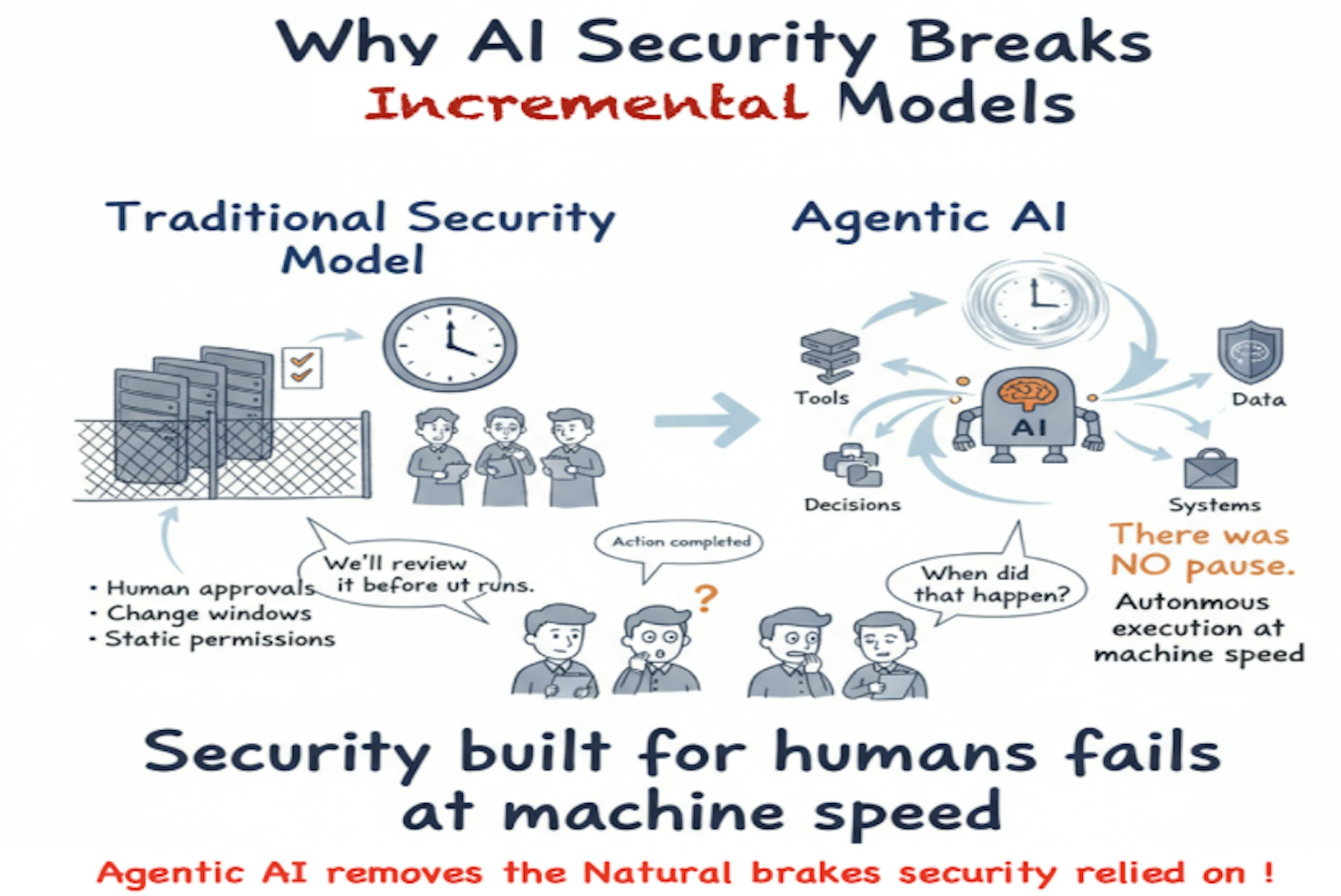
Unlike prior technology shifts, AI adoption is not organic or incremental. Enterprises are not simply extending existing cloud workflows. They are introducing autonomous, always-on systems that reason, act, and access data continuously at machine speed.
Treating AI security as an add-on to traditional cloud security repeats the same mistake enterprises made when they tried to bolt virtualization security onto physical data center models. Only now, the blast radius includes autonomous decision making, continuous execution, and direct access to critical business data.
This distinction matters.
In traditional cloud environments, security failures were often bounded by human involvement, approval workflows, and operational friction. AI removes those natural brakes. A single misconfiguration, over-permissioned identity, or weak boundary can now be amplified instantly by agentic systems operating at scale.
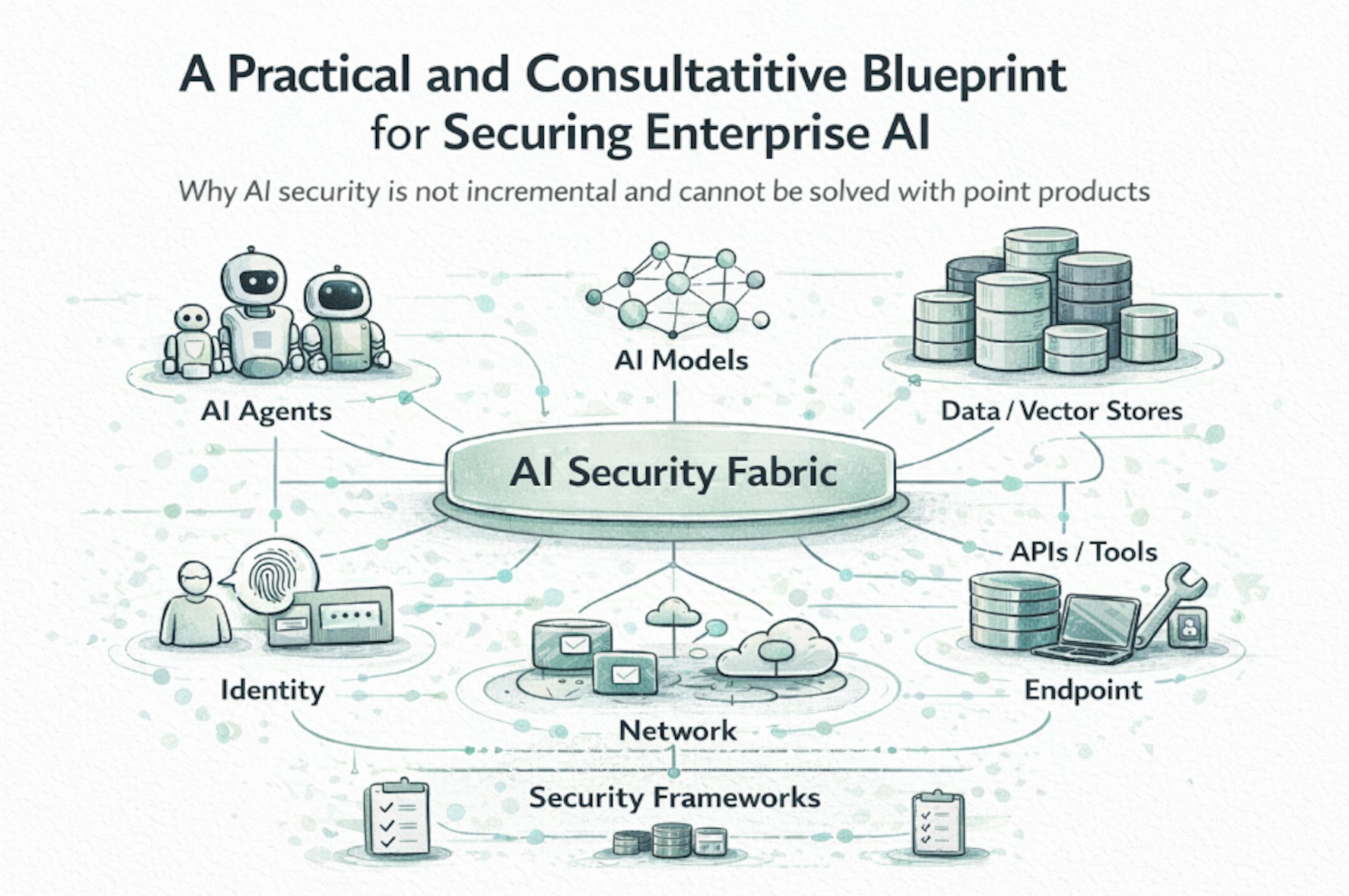
This is why AI security cannot be approached as a collection of point products. Securing AI requires a system-level view, where intent is defined centrally and enforced continuously at runtime across identity, network, endpoint, workload, data, and AI layers.
This framing is critical for understanding why control planes and runtime enforcement appear throughout the rest of this blueprint.
The Architecture of Enterprise AI
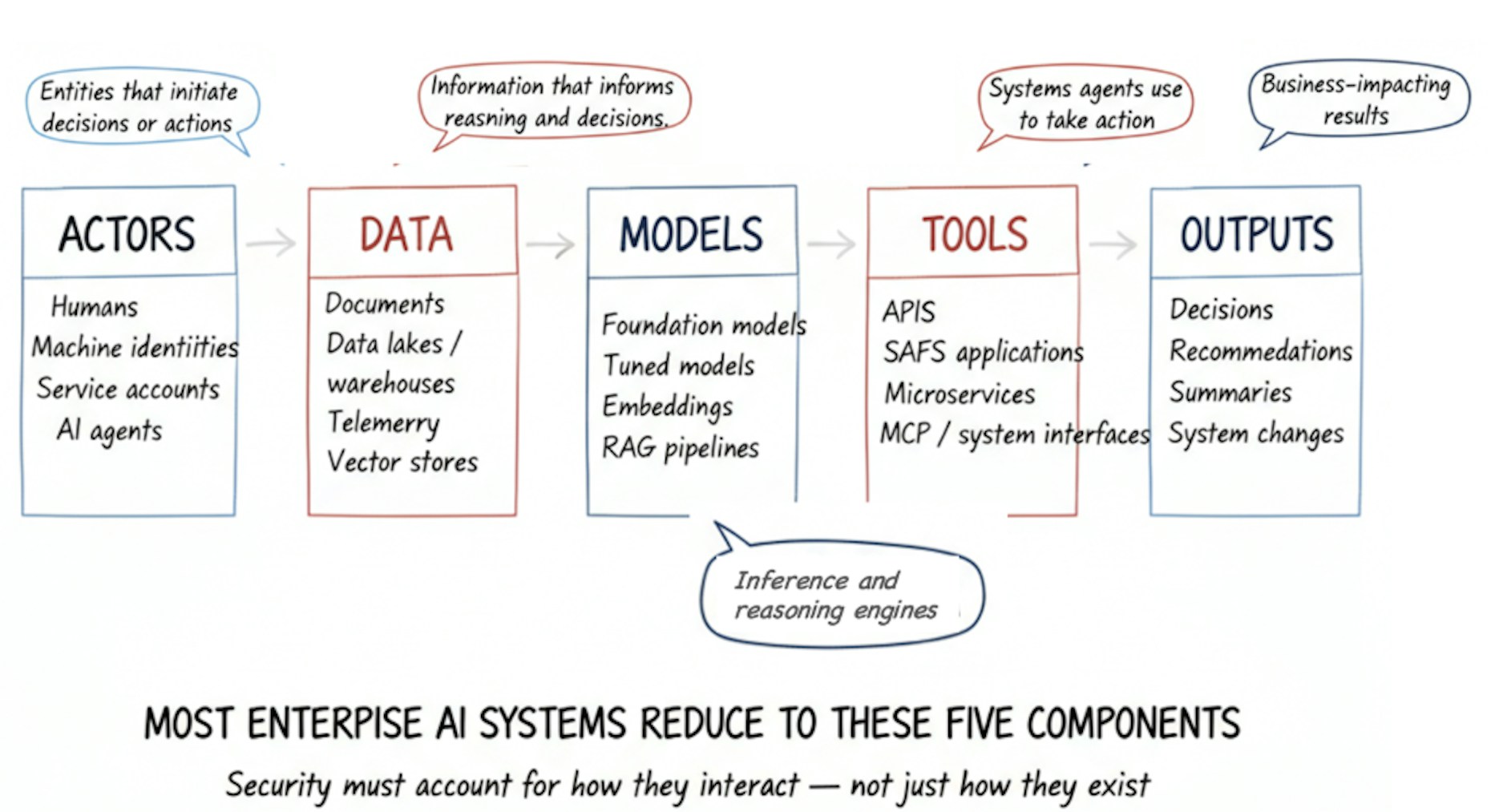
Even the most sophisticated AI environments reduce to five functional components:
- Actors. Humans, machine identities, service accounts, and autonomous agents with decision-making or operational authority.
- Data. Data lakes, warehouses, documents, telemetry feeds, and vector stores that inform models and agents.
- Models. Foundation models, tuned models, embeddings, inference endpoints, and retrieval-augmented generation pipelines.
- Tools. APIs, SaaS applications, microservices, and system-level interfaces that agents can call to take action.
- Outputs. Decisions, summaries, recommendations, or system changes that affect business workflows.
Understanding these components and how they interact is essential for designing security that scales.
How an AI Workflow Operates in Practice
A simple example illustrates this clearly.
A user asks:
“Show me the last ninety days of payment anomalies for customer 92831 and prepare a summary for finance.”
Behind this single prompt:
- Identity validation confirms the user’s permissions.
- A supervisor agent coordinates the request.
- A data agent retrieves sensitive financial data.
- An analysis agent applies anomaly detection using a model.
- A writer agent prepares the narrative summary.
- A human reviewer approves the action.
- The summary is routed into finance systems.
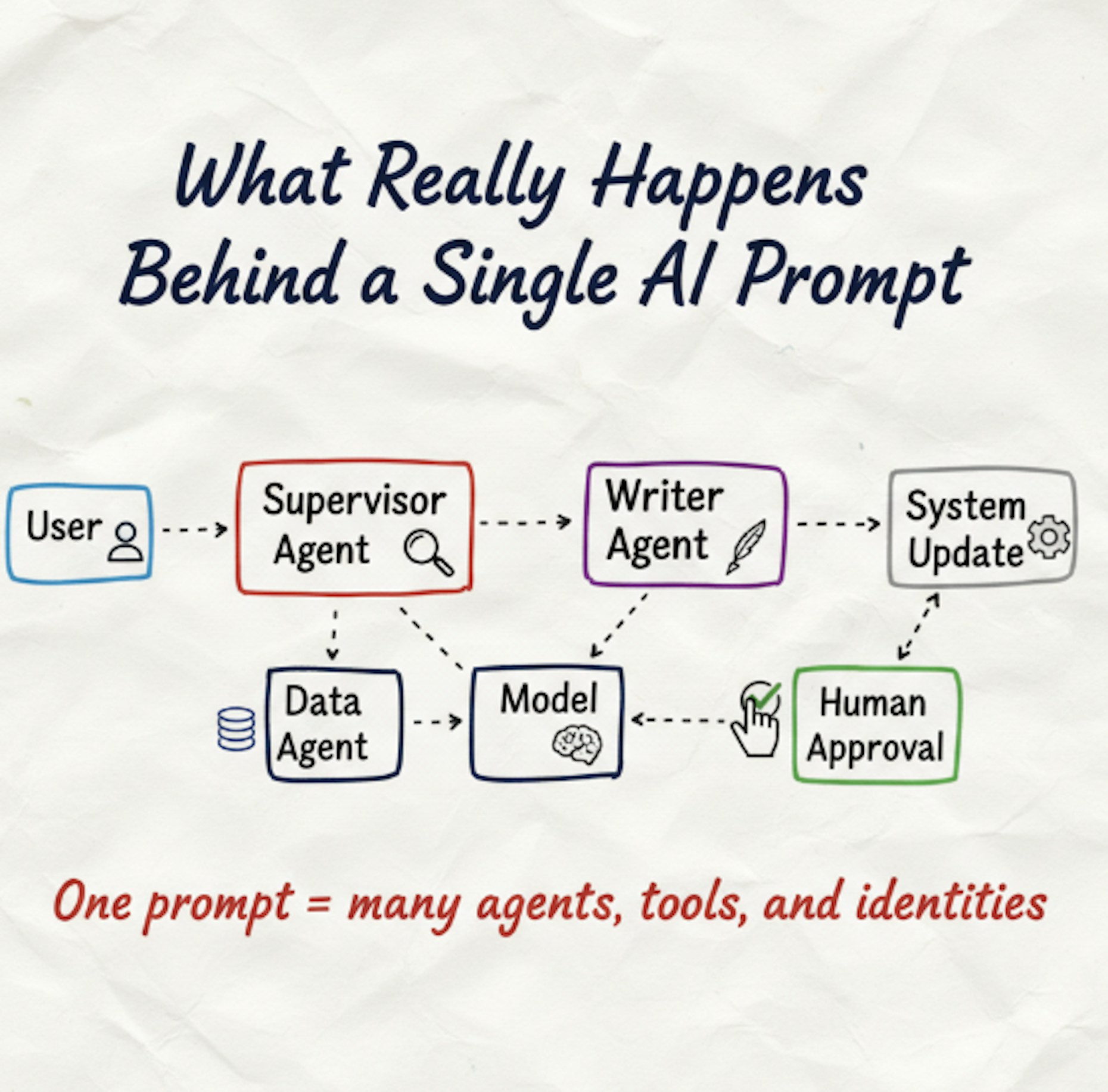
This is the operational reality of enterprise AI. Multiple agents, models, tools, and datasets interact dynamically, often with real-world consequences. Securing AI therefore requires a holistic and coordinated approach.
Where AI Systems Fail
AI introduces new classes of vulnerabilities that traditional security programs are not designed to handle.
- Prompt injection. Malicious or cleverly constructed inputs override system rules.
- Jailbreaking. Restructured prompts bypass safeguards through role play or linguistic manipulation.
- RAG poisoning. Adversaries insert manipulated content into knowledge bases that the model trusts.
- Agent impersonation. Attackers use compromised credentials to act as legitimate agents.
- Over-permissive tools. Agents are given broad API access, enabling unintended system-level changes.
- Adversarial inputs. Subtle perturbations produce incorrect or harmful outputs.
- Data leakage. Retrieval pipelines return information outside intended scope.\
- Model drift. Model behavior shifts silently as data changes.
- Hallucinations. Models produce confident but incorrect outputs that influence real decisions.
These risks appear at different layers, which is why fragmented, tool-by-tool approaches fail.
It’s also critically important to understand, that Not all AI failures are the result of adversarial attacks.
Agentic systems can also fail through valid, authorized actions executed in the wrong context. These failures occur without malicious intent and are often invisible to traditional security controls.
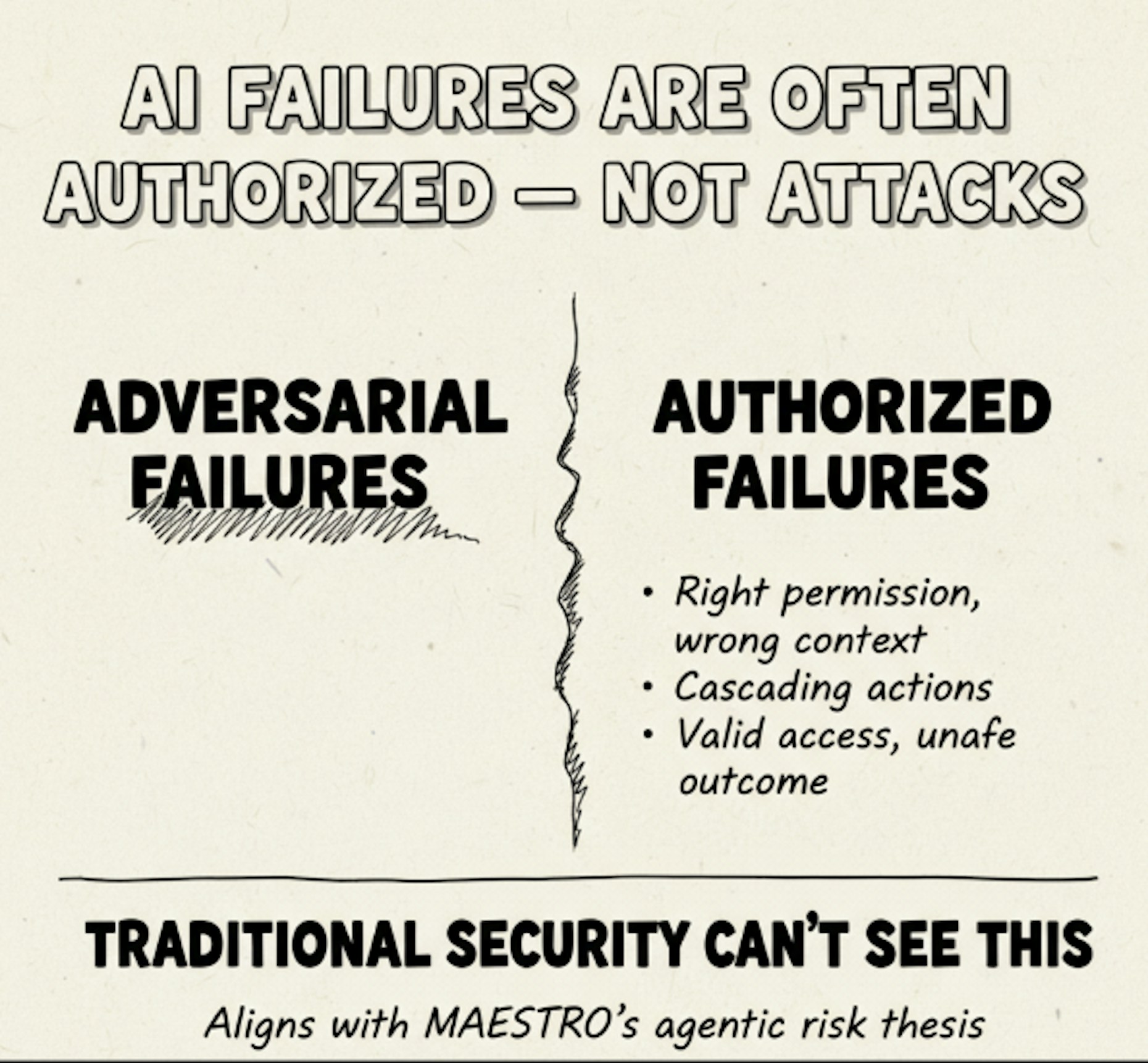
Autonomous agents operate continuously, at machine speed, and across multiple systems. When access is overly broad or boundaries are weak, agents can combine data, tools, and actions in ways no human explicitly intended.
Examples include:
- Legitimate agents traversing unintended network paths
- Correct permissions applied in the wrong environment
- Data access that is individually allowed but collectively unsafe
- Cascading actions that amplify small configuration errors
Traditional preventive security assumes human-paced decision making. It is not designed to detect or contain this class of failure. This is why identity alone, even when modernized, is insufficient without runtime enforcement and contextual containment.
What Industry Frameworks Are Telling Us
Across community standards and cloud-specific frameworks, the guidance is converging.
Community frameworks (examples)
- NIST AI RMF
- ISO governance models
- OWASP AI Security
- Cloud Security Alliance AI safety guidelines
Cloud provider frameworks (examples)
- Google Secure AI Framework (SAIF)
- AWS CAF-AI
- Azure Secure AI
- Databricks DASF
Taken together, these frameworks emphasize six consistent security domains:
- Identity and access governance
- Data protection and provenance
- Model security and robustness
- Agent safety and responsibility boundaries
- Tool and action authorization
- Monitoring, traceability, and human oversight
This convergence underscores the foundational elements of a modern AI security strategy, which means bringing frameworks together into controls that make sense for each enterprise.
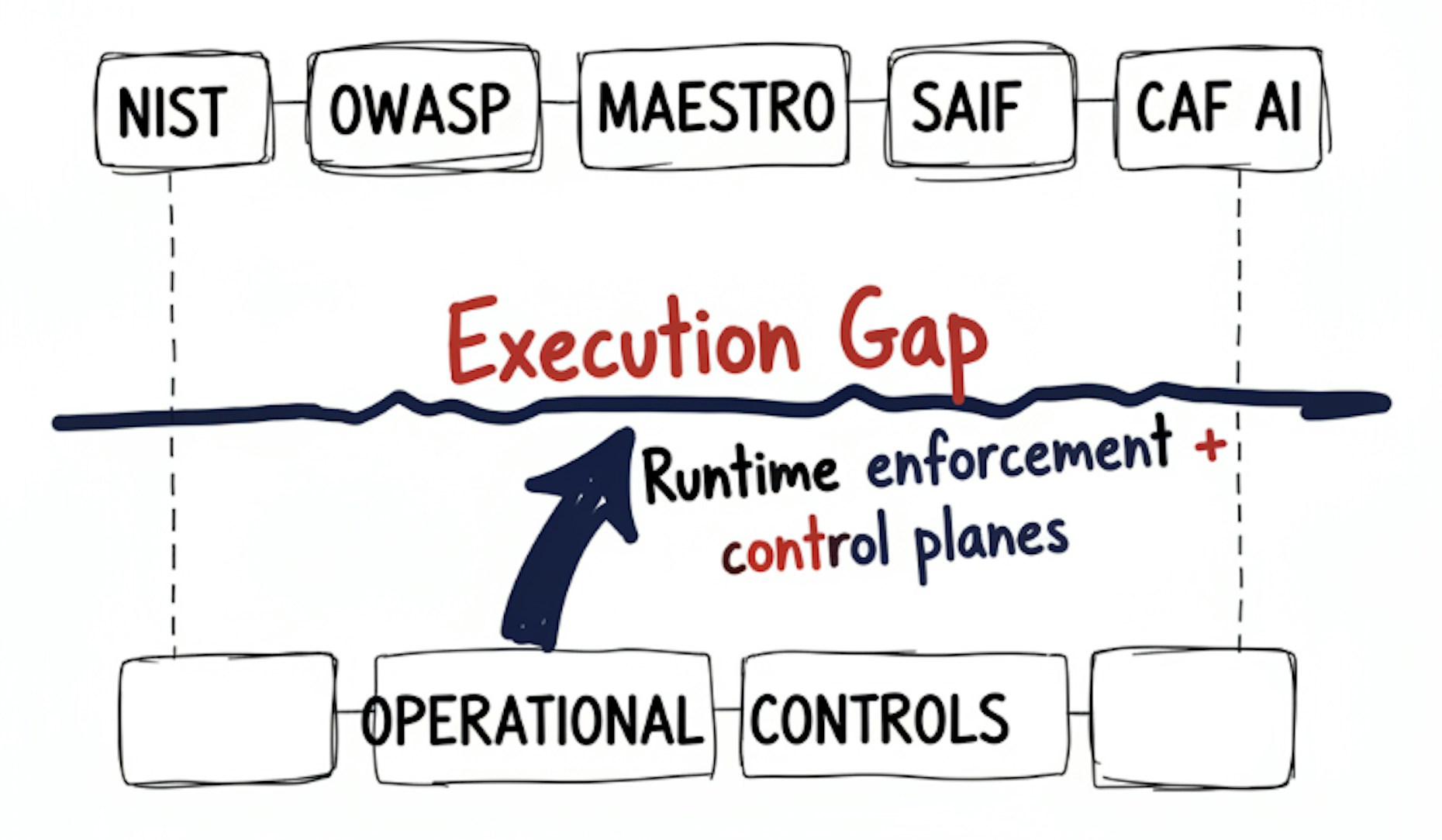
Converting Frameworks into Operational Controls
Frameworks offer directions. Enterprises need mechanisms that enforce these behaviors in production.
Effective operational controls include:
- Identity federation and just-in-time access
- Short-lived credentials for every agent action
- Validation and sanitization of rag data
- Retrieval boundaries based on user or agent identity
- Adversarial testing and jailbreak evaluation of models
- Model version control and rollback
- Supervisor agents and approval steps for high-impact tasks
- Monitoring for drift and anomalous behavior
- End-to-end auditability
- Runtime authorization for tool invocation
Security becomes practical only when it becomes enforceable, observable, and measurable inside live workflows.
Enterprise Anchor Points
Anchor points are non-negotiable design principles that shape every decision. They simplify governance and create consistency across teams.
Examples include:
- No human or agent receives standing or overly broad permissions.
- High-impact actions require supervisor agent involvement and human approval.
- All datasets used for retrieval must be validated, governed, and sanitized.
- All agent actions must be tied to time-bound credentials.
- Every model, dataset, and agent must have clear ownership.
These principles guide architecture, vendor selection, and operational behavior.
Embedded Foundational Pillars of the AI Security Fabric: Network, Endpoint, and Identity
Identity has already been established as a critical control for securing AI systems. But in agentic environments, identity does not operate in isolation, nor can it absorb the full blast radius of autonomous, machine-speed systems on its own.
To make AI security effective in practice, identity must be embedded alongside network and endpoint controls as part of a single, cohesive security fabric. These layers form the foundational pillars that constrain where AI agents can operate, how workloads execute, and what environments identities are allowed to act within.
AI security is not isolated from traditional infrastructure.
- Network controls limit lateral movement, enforce segmentation, and detect anomalous traffic patterns. Many agentic workflows begin with signals from NDR platforms identifying suspicious behavior before it manifests at the AI or application layer. In practice, network segmentation, traffic enforcement, and policy-driven connectivity increasingly form part of a modern security fabric. Solutions such as Aviatrix help establish distributed, cloud-native network security fabrics that enforce isolation, segmentation, and encrypted connectivity across multi-cloud environments. Broader platform providers such as Cisco, Palo Alto Networks, and ZScaler have similarly articulated security fabric strategies that converge identity-aware access, network enforcement, and workload protection, moving enforcement closer to where users and workloads actually operate rather than relying on centralized choke points.
- Endpoint and workload protections safeguard user devices, model-serving hosts, CI/CD runners, plugin ecosystems, and secrets storage. In practice, many AI failures originate from compromised runtimes or execution environments rather than the model itself. Endpoint and workload integrity signals often originate from platforms such as CrowdStrike, providing early detection of execution tampering, credential misuse, and abnormal runtime behavior.
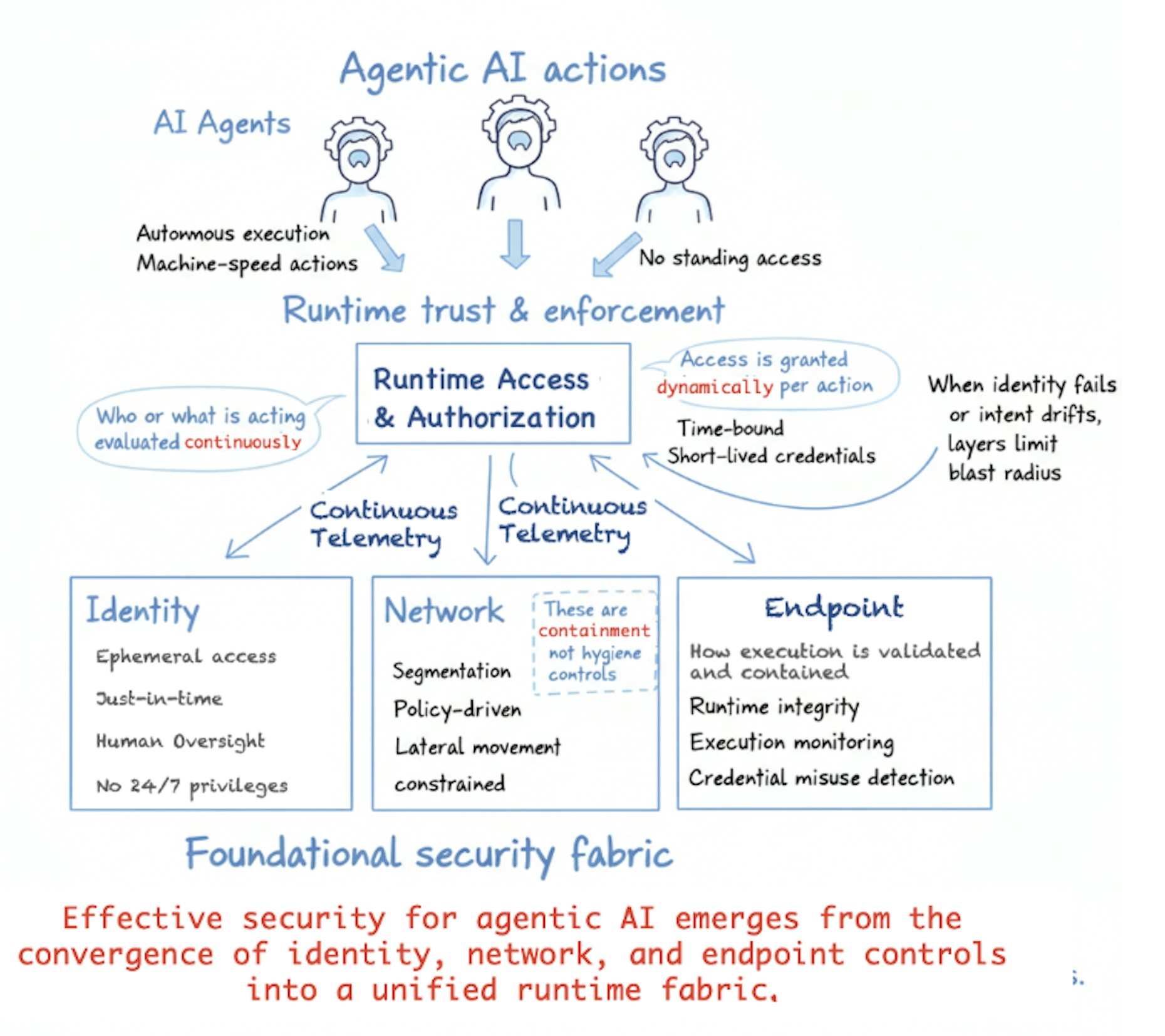
Identity context increasingly comes from modern identity platforms including Okta, Microsoft Entra, and cloud-native identity systems such as Britive, which provide dynamic access context and help eliminate standing privilege through ephemeral, just-in-time access models.
Both network and endpoint layers continuously feed telemetry into the AI Trust Control Plane, enriching context, strengthening enforcement, and improving decision-making across the system.
These controls are often treated as legacy hygiene in AI discussions. This is a mistake.
In agentic environments, network and endpoint protections are runtime containment mechanisms. When identity fails, credentials are reused, or intent drifts, these layers limit blast radius and prevent mistakes or misuse from propagating unchecked.
Network segmentation constrains where agents can move and which systems they can reach. Endpoint and workload protections detect execution tampering, credential misuse, and abnormal runtime behavior. Together, and in combination with modern identity controls, they protect against both adversarial compromise and unintended autonomous actions.
Without these embedded foundations, AI systems operate in flat, high-trust environments where failures escalate instantly and invisibly, often before humans can intervene.
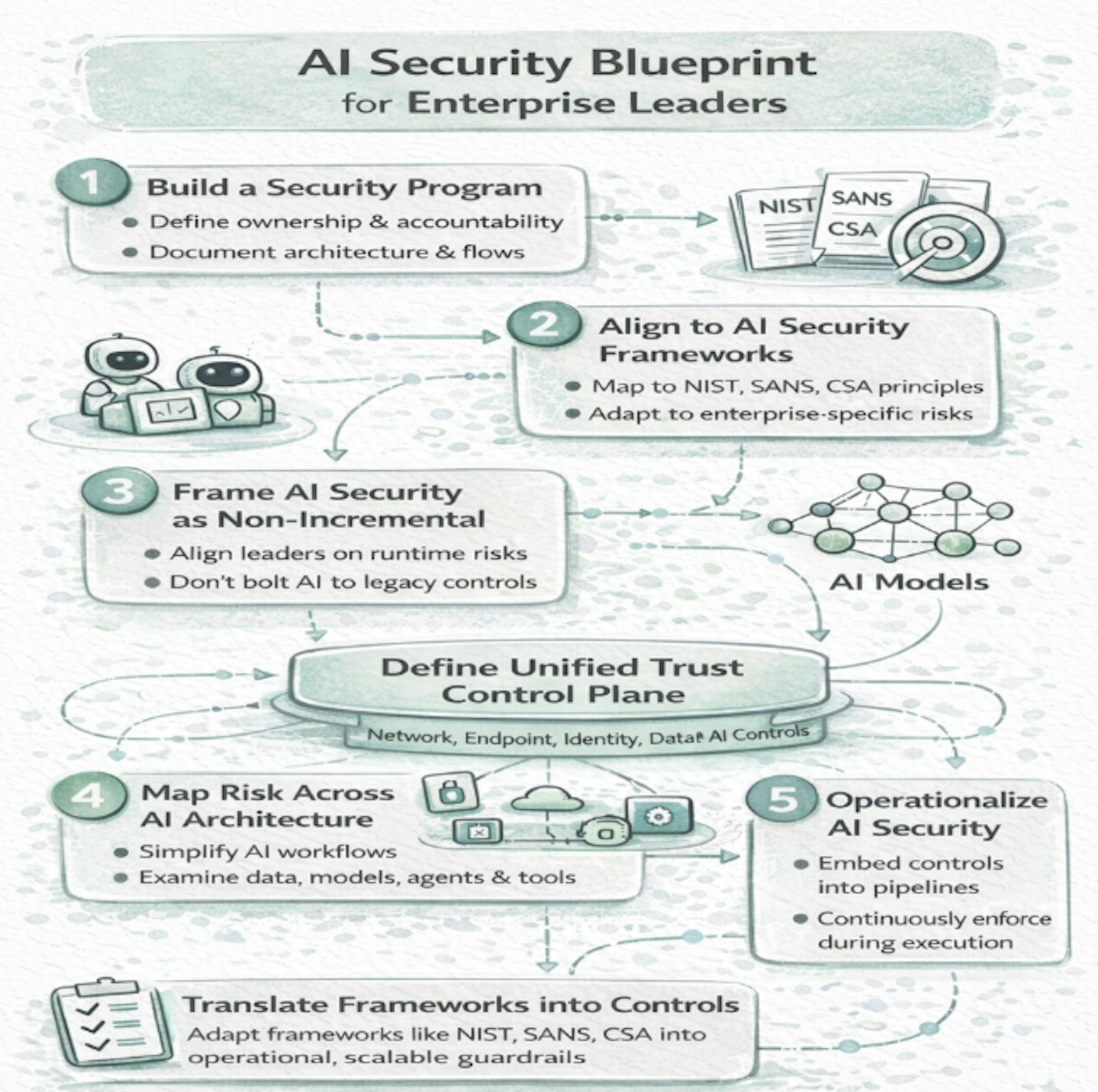
How Enterprises Put AI Security into Practice
Most organizations struggle, not because frameworks are unclear but because operational structure is missing. Implementing AI security requires deliberate organizational steps.
- Establish a dedicated AI security program -Traditional AppSec and IAM teams are not structured to manage RAG hygiene, agent governance, model drift, or adversarial ML. A dedicated program is essential.
- Create an AI Center of Excellence - Bring together leaders from security, data, ML, engineering, governance, and compliance. This group defines enterprise-wide principles, anchor points, oversight, and cloud alignment.
- Develop skills that match the new risk landscape - Security teams learn adversarial ML and model behavior evaluation. Developers learn prompt and tool safety. SOC teams integrate AI-specific telemetry into detection workflows.
- Create AI-specific KPIs - Examples: jailbreak success rate, hallucination ratio, RAG validation coverage, agent over-permission scoring, model drift indicators, human-approval coverage.
- Start small, then scale - Secure one high-value use case deeply, measure performance, refine controls, and expand systematically.
- Prioritize governance - Every model, agent, dataset, and tool interface should have documented responsibilities, policies, controls, and ownership. This consultative sequence gives enterprises a path from vision to implementation.
Where First-Generation AI Security Layers Fit and Where They Fall Short
As enterprises adopt AI, security discussions often center on first-generation, inference-centric AI security layers such as model security, prompt security, and data security. These controls play an important role, but they primarily operate before or around inference, not during execution.
Model security helps ensure that foundation models and fine-tuned models behave within expected bounds. This includes evaluation, alignment testing, guardrails, and drift detection. These controls reduce risk at design and deployment time, but they do not govern how models are used once agents begin acting autonomously in production environments.
Prompt and context security attempts to prevent manipulation of inputs through prompt injection, context poisoning, or retrieval abuse. These protections are necessary, but increasingly brittle. As agentic systems chain tools, retrieve external knowledge, and generate their own intermediate prompts, static prompt defenses alone cannot provide reliable guarantees.
Data security governs access to training data, inference data, and retrieved knowledge sources. Classification, masking, lineage, and provenance controls are foundational. However, in agentic systems, data risk often emerges not from what the model sees, but from what actions it is allowed to take after reasoning over that data.
The critical limitation of these approaches is that they operate primarily before or around inference. Agentic risk materializes during execution.
This is why AI security must evolve beyond individual layers toward runtime enforcement. Model, prompt, and data protections remain necessary inputs, but they become effective only when their signals feed into a broader Trust Control Plane that governs whether actions are allowed to occur, under what conditions, and with what blast radius.
In practice, enterprises should treat traditional AI security layers as risk signals, not decision points. The decision itself must occur at runtime.
The AI Trust Control Plane
Historically, identity has not been treated as a core cybersecurity control. It has primarily functioned as an administrative system focused on access provisioning rather than runtime risk management. As enterprises adopted cloud, SaaS, containers, and Kubernetes, identity architectures largely remained static, vault-based, and dependent on standing access.
Agentic AI exposes the limitations of this model.
Agentic systems plan and execute actions autonomously across infrastructure, applications, and data systems. Security controls that rely on static permissions or post-execution detection are insufficient when actions occur continuously and without human intervention. In these environments, trust must be evaluated at execution time using real operational context.
To address this, identity must evolve from a one-time gate into a continuous decision input. However, effective AI security requires identity to be combined with network context, workload integrity, behavioral signals, data sensitivity, and AI-specific constraints within a unified trust control plane.
In this operating model, identity establishes who or what is acting and under which conditions. The Trust Control Plane governs where actions may occur, how they are executed, and what boundaries apply if risk increases.
This convergence transforms the Trust Control Plane from a conceptual framework into an operational control system.
What the AI Trust Control Plane Is in Practice
The AI Trust Control Plane is not a standalone product. It is an architectural pattern that enterprises implement by coordinating trust signals, authorization logic, enforcement points, and audit systems across their existing security and AI platforms.
At runtime, the Trust Control Plane answers a specific operational question:
Is this action permitted given the actor, the context, and the current risk state?
To support that decision, the control plane aggregates and evaluates multiple categories of signals:
- Identity governance for both human and non-human actors
- Network and endpoint telemetry describing execution environment and behavior
- Data lineage and sensitivity indicators
- Model and agent safety signals including drift and anomalies
- Policy-as-code used for runtime authorization
- Human approval workflows for sensitive or high-impact actions
- SOC systems for detection, investigation, and response
- Continuous monitoring for misuse and abnormal patterns
Together, these signals form a single operational fabric spanning identity, network, endpoint, data, model, agent, and tool security.
Where Trust Decisions Are Visible to Security Leaders
A common concern is where trust decisions are surfaced for security leadership. In practice, the Trust Control Plane becomes visible through existing operational systems rather than a new centralized console.
First, trust decisions are recorded as structured events. Each runtime authorization decision generates an auditable record capturing the actor, attempted action, evaluated context, policy outcome, and enforcement result. These records flow into SIEM, SOC, and audit platforms where they support incident response, reporting, and compliance.
If an authorization decision is not logged centrally, it cannot be governed.
Second, enforcement occurs at distributed control points. Identity systems issue short-lived credentials. Network platforms enforce segmentation and egress restrictions. Endpoint and workload systems enforce runtime integrity. Agent frameworks enforce tool and capability boundaries. Human approval systems gate high-risk actions. The Trust Control Plane coordinates these enforcement points by ensuring they are context-aware and invoked at execution time.
Third, security leaders operate the Trust Control Plane through correlated views built from trust decision data. These views answer practical questions such as which agents are operating with elevated privileges, which actions required human approval, where execution was constrained, and where anomalous behavior is emerging. These insights are derived from existing SOC and governance workflows rather than vendor-specific dashboards.
How Runtime Enforcement Works
The Trust Control Plane enforces security at execution time. Agentic systems do not hold permanent access. They receive short-lived, scoped credentials only when an action is authorized based on current context.
A standard enforcement sequence follows this pattern:
- An agent proposes an action
- Relevant context is collected including identity, environment, data sensitivity, and behavioral signals
- Authorization policy is evaluated
- A decision is returned to allow, constrain, or deny the action
- The outcome is enforced through identity, network, endpoint, or application controls
- The decision and result are logged for investigation and audit
This approach eliminates standing privilege, enforces least privilege dynamically, and maintains accountability across autonomous actions.
How Enterprises Implement the Trust Control Plane
Organizations do not need to replace their existing security stack to implement a Trust Control Plane. They operationalize it by aligning systems around consistent trust decisions.
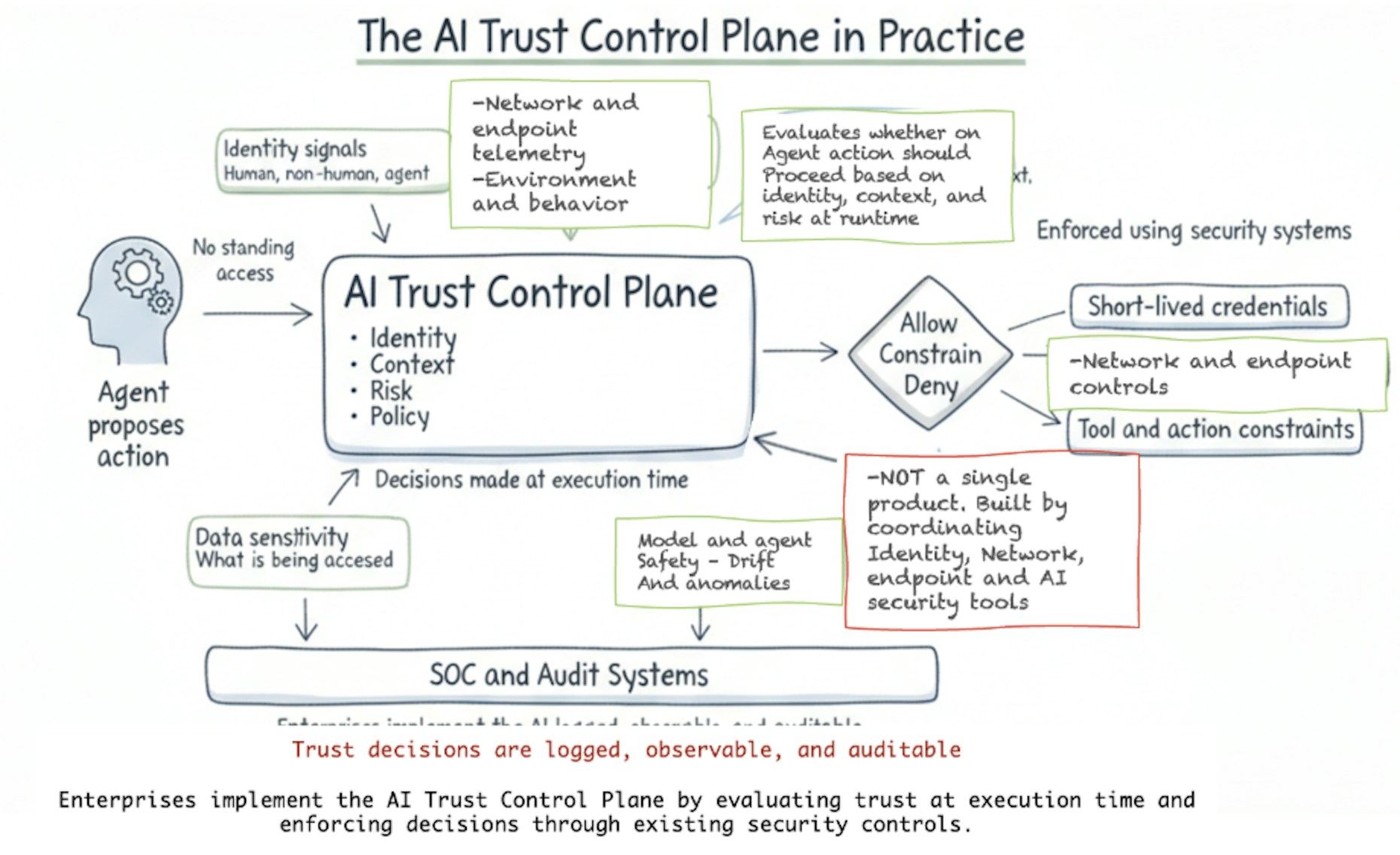
In practice, enterprises take the following steps:
- Identify where agent actions occur and where authorization must be evaluated
- Standardize trust decision events and logging formats
- Enable short-lived credential issuance and revocation
- Integrate policy evaluation into agent execution paths
- Ensure enforcement systems can act on authorization outcomes
- Aggregate trust decision data into SOC and governance workflows
Existing identity, network, endpoint, and logging platforms already provide many of the required signals and enforcement mechanisms. AI-aware runtime controls extend those decisions into agent-specific actions such as tool invocation, data access, and infrastructure changes.
Platforms built for modern security contribute to this architecture by providing runtime identity authorization and just-in-time access for both human, non-human, and agentic identities. Other tools supply telemetry, enforcement, and governance capabilities.
The Trust Control Plane emerges from their coordination, allowing organizations to evaluate access dynamically, constrain actions based on context, and maintain visibility across autonomous systems. Organizations can govern agent behavior and access without impeding innovation or relying on static permissions.
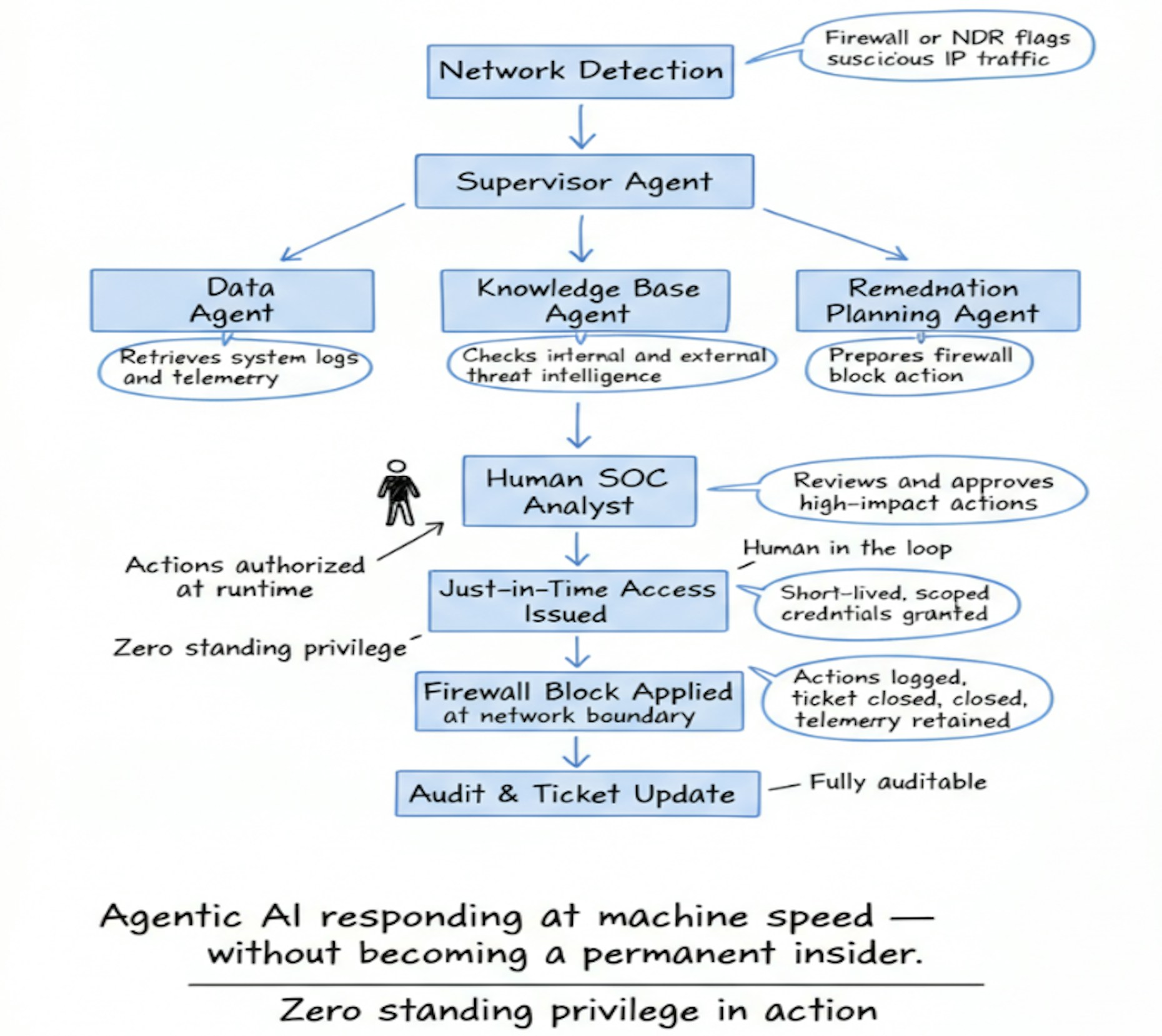
A Real-World Example: Agentic SOC for Malicious IP Detection
The following illustrates how these principles operate together. Imagine a malicious IP is flagged for communicating with a backend database.
- Firewall or NDR identifies suspicious traffic.
- SIEM correlates the event and escalates severity.
- A supervisor agent triggers a multi-agent workflow.
- A data agent retrieves system logs and telemetry.
- A knowledge base agent checks internal and external threat intelligence.
- A remediation agent prepares a block rule.
- A human in the loop approves the action.
- The remediation agent receives short-lived credentials.
- The firewall block is applied.
- The supervisor agent updates the ticket and logs actions.
This cycle enforces zero standing privilege, validates data sources, uses human oversight, and provides consistent auditability.
Conclusion
Agentic AI represents a fundamental shift in how software systems operate inside the enterprise. These systems do not simply generate outputs for human review. They reason, plan, and act autonomously across infrastructure, applications, data, and business processes. This shift introduces operational risk that cannot be addressed using controls designed for static software or human-paced workflows.
The central challenge of agentic AI security is not understanding risk. It is enforcing trust at execution time.
Security models that focus only on model safety, prompt validation, or post-execution monitoring fail once systems can take action without human intervention. In agentic environments, security must operate continuously, using real identity context, environment signals, behavioral telemetry, and policy evaluation at the moment actions are attempted.
This blueprint has outlined how enterprises can approach that challenge in a practical way.
The AI Trust Control Plane described in this document is not a single product or platform. It is an architectural control pattern that enterprises implement by coordinating existing identity, network, endpoint, data, and AI runtime controls around a consistent model for trust decisions, enforcement, and auditability. Security leaders already operate these systems today. What changes is when they are applied, how they are connected, and how decisions are enforced.
Organizations that succeed with agentic AI will be those that move security controls closer to execution. They will replace standing access with short-lived, context-aware authorization. They will treat network and endpoint protections as runtime containment layers rather than background hygiene. They will ensure that every autonomous action is bounded, observable, and accountable.
Agentic AI can deliver significant business value, but only when autonomy is matched with control. The enterprises that adopt this mindset will be able to move faster without surrendering governance, safety, or trust.