

Back to resources
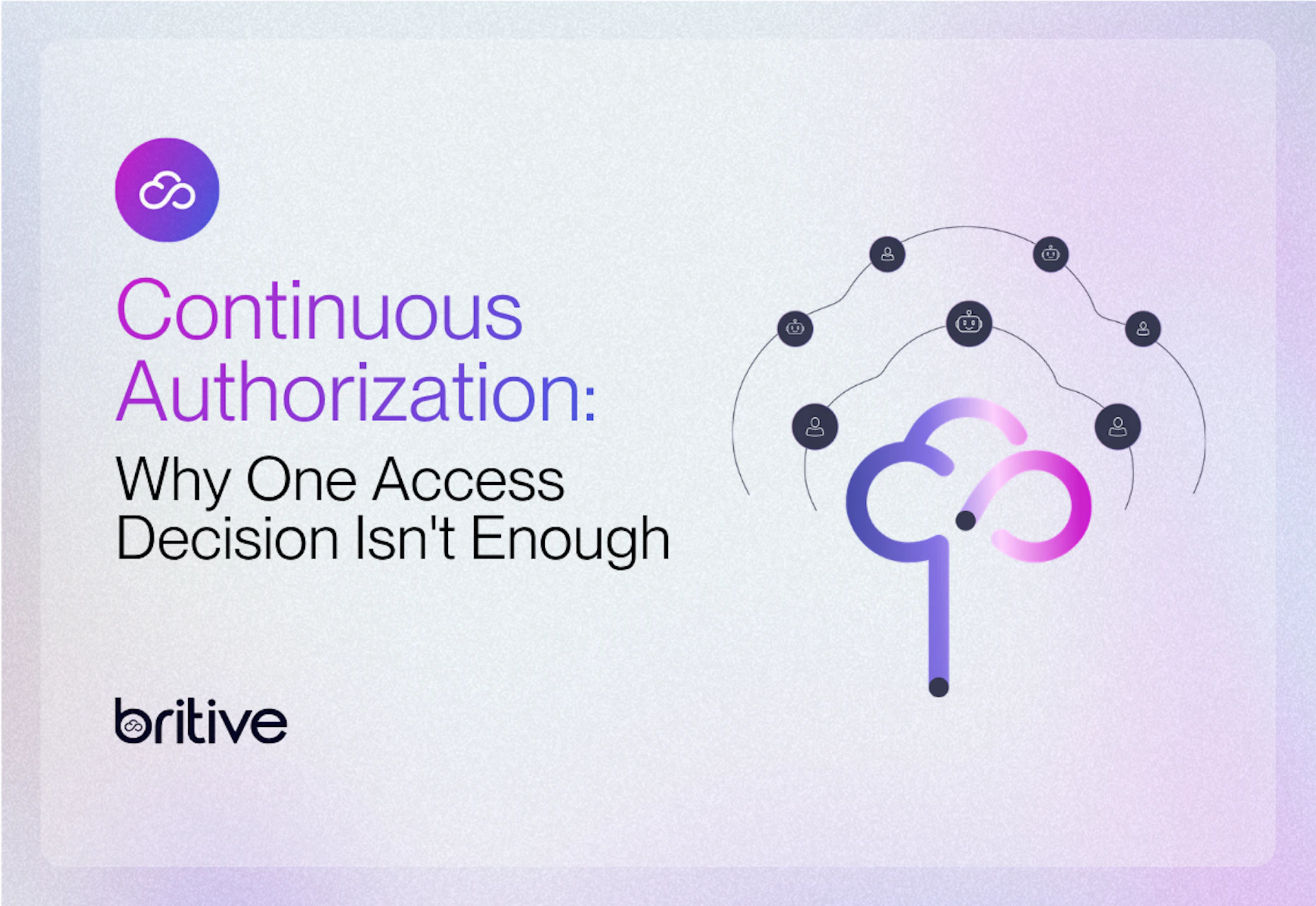
Continuous Authorization: Why One Access Decision Isn't Enough
August 2026 / 8 min read. /
What Continuous Authorization Is
Continuous authorization is the practice of re-evaluating an access decision repeatedly while a session is active, rather than settling it once at the moment access is granted. The decision isn't treated as final; it’s checked again throughout the session as conditions change.
If the context that justified access no longer holds, the access responds: it narrows to a smaller scope, requires a step-up approval before continuing, or ends outright. The principle is simple. Access should last exactly as long as the conditions that justified it, and not a second longer.
That represents a shift in what an access decision is. Instead of a one-time gate that opens and stays open, authorization becomes an ongoing judgment, closer to authorizing access in real time than to issuing a pass at the door and looking away.
Continuous Authorization vs. Runtime Authorization
Two similar terms that work together but mean slightly different things.
Runtime authorization answers when the decision is made. Privilege is created at the moment of the request rather than provisioned in advance, so it closes the gap between tasks. There is no standing privilege sitting idle, waiting to be found and used.
Continuous authorization answers how long that decision holds. Even a privilege granted at runtime is a snapshot: it is correct at second zero and may be wrong ten minutes into the task. Continuous evaluation and authorization closes the gap during a task.
They are sequential layers of security, not competing options. Runtime authorization is the foundation while continuous authorization is what allows that foundation to scale.
The reason is architectural. You can't re-evaluate a permanently provisioned entitlement, because revoking a session doesn’t help if the standing privilege is still there when the session ends. Ephemeral privilege is what makes continuous evaluation coherent in the first place.
Runtime authorization decides whether privilege should exist at the moment of the request. Continuous authorization decides whether it should continue to exist.
Why a Single Authorization Decision Goes Stale
Every authorization decision is made against a picture of the world at one instant: this identity, this task, this device, this risk level, right now. The decision is only as good as that picture at a single point in time, and the picture often changes throughout a task.
Consider what can shift while a session is still open. A device falls out of compliance. A risk score climbs. The same credential turns up compromised somewhere else in the environment. Behavior starts to deviate from anything the identity normally does. An agent begins taking actions outside the intent it was authorized for. None of these events undo the grant that has already been made. Under a single-decision model, access simply continues until the timer runs out.
The long-session problem
The longer a session runs, the more the world can change inside it, and the wider the exposure grows. A three-minute task and a three-hour one carry very different risk under the same fixed grant, even though both were authorized identically. Time-bounding access helps, but it only sets an outer limit. It does not react to anything that happens inside that window.
Why AI agents make this urgent
Autonomous agents sharpen the problem. An agent's behavior is non-deterministic: what it does at minute ten may bear little resemblance to the intent it was authorized for at minute zero, because it is selecting tools and reacting to inputs as it goes. Authorizing an agent once, at the start, assumes a predictability agents do not have. Machine speed compounds it, since an agent can take thousands of actions inside a window a human would use for a handful.
How Continuous Authorization Works
Mechanically, continuous authorization is a loop: signals come in, policy is re-evaluated, and an action follows.
Consuming risk signals
The system listens for signals from outside itself: identity providers, endpoint detection tools, device posture services, and SIEM platforms all know things that matter to an access decision. The important part is how those signals travel. Open standards such as the Shared Signals Framework (SSF) and the Continuous Access Evaluation Profile (CAEP) let security tools exchange risk and session events in a common format instead of through one-off, proprietary integrations.
That neutrality matters in practice. Enterprises run multi-vendor stacks, and signals that only flow between products from the same vendor leave most of the environment unheard. A standards-based approach means a signal from the broader security stack can inform an access decision regardless of which vendor produced it.
Re-evaluating against policy
When a signal arrives, the decision is reassessed against current conditions rather than the conditions that existed at grant time. Attribute-based and policy-based access control (ABAC and PBAC) make this possible, because the policy is expressed in terms of attributes and context that can be re-read at any moment. This is the same logic behind context-aware access policies, applied continuously instead of once.
Acting on the change
Re-evaluation is only useful if something happens as a result, and the response does not have to be all-or-nothing. There are three:
- Narrow the scope. Reduce what the identity can do while allowing legitimate work to continue.
- Require step-up. Ask for additional verification or human approval before the session proceeds.
- Revoke outright. End the access immediately, so the privilege is revoked mid-session rather than at expiry.
What Continuous Authorization Is Not
One clarification prevents a common misreading: continuous authorization is continuous decision-making, not continuous surveillance.
Session monitoring and recording observe what happened and raise an alert for someone to review, usually after the fact.
Continuous authorization evaluates and enforces in the moment. One watches; the other acts. The distinction matters because “continuous” is easy to hear as “always being monitored,” which describes the grant-and-observe model this approach is meant to replace. Watching privileged activity more closely is not the same as authorizing it as conditions change.
Continuous Authorization Across Identities
The same model applies wherever a session can outlive the conditions that justified it, and the case grows stronger as behavior becomes less predictable.
- Human sessions. Long administrative sessions are the classic example: an engineer opens a session, and context shifts underneath it while the work continues.
- Machine and non-human identities. Workloads, service accounts, and automations often run continuously, which means a single authorization decision can govern activity for hours or days.
- AI agents. The strongest case, because agent behavior is the least predictable. Combined with authorization at the level of each tool call, continuous evaluation keeps an agent's access aligned with what it is actually doing, not what it was expected to do.
Across all three, the point is consistency: one policy model, one set of signals, one audit trail, rather than a separate approach per identity type.
Where Continuous Authorization Fits on the Access Security Maturity Curve
It helps to see these as three stages in improving security posture, rather than the need for three different products:
- Stage one: access provisioned ahead of need. Permissions are assigned at identity creation or through role groups and persist whether or not they are used. This is where most organizations still operate.
- Stage two: access decided at runtime. Privilege is created when it is requested and retired when the task ends, producing zero standing privilege through ephemeral permissioning.
- Stage three: access re-evaluated continuously. The decision itself stays live for as long as the session does.
Many organizations are still working to implement stage two. Treat continuous authorization as the direction of travel rather than an entry requirement. The most practical move is to eliminate standing privilege first, then extend the decision across the life of the session.
What Continuous Authorization Changes
When authorization happens beyond a single point in time, several things change at once:
- A mid-session compromise stops meaning free rein. An attacker who takes over an active session no longer inherits the remainder of its lifetime; the moment a signal reflects the change, the access can narrow or end.
- Zero Trust becomes continuous. "Never trust, always verify” turns into something enforced throughout the session instead of verified once at the door.
- The audit trail gets richer. Evidence shows not only what was granted, but how the decision adapted and why, which is a more useful record for audit and compliance than a static grant log.
- The exposure window shrinks. Instead of being bounded by session length, the window is bounded by how quickly a signal arrives and is acted on.
Britive's Approach
Britive starts with runtime authorization: privilege is created when it is requested and retired when the task ends, so there is no standing privilege to re-evaluate in the first place. Continuous authorization builds directly on that foundation.
Britive supports the Shared Signals Framework today, consuming risk and session events from the surrounding security stack and reassessing active sessions against attribute-based and policy-based policy rather than relying solely on the decision made at the moment of the grant. When a signal indicates that conditions have changed, access can be narrowed, escalated for approval, or ended outright. Because the underlying privilege is ephemeral, ending it mid-session leaves nothing behind to clean up or revoke separately.
Britive is one of the first privileged access vendors to support the Shared Signals Framework, which is less a milestone than a reflection of where the architecture already pointed: a platform built to authorize at runtime is the one best positioned to keep authorizing continuously.
For a fuller view of how the architecture differs from vault-and-rotate approaches, see what sets Britive's model apart.
FAQ
How is continuous authorization different from runtime authorization?
'%20stroke-width='2'/%3e%3cdefs%3e%3clinearGradient%20id='paint0_linear_1063_5522'%20x1='0.871795'%20y1='1.23504'%20x2='20.1122'%20y2='10.6379'%20gradientUnits='userSpaceOnUse'%3e%3cstop%20stop-color='%23CA1ECC'/%3e%3cstop%20offset='1'%20stop-color='%233E5DE0'/%3e%3c/linearGradient%3e%3c/defs%3e%3c/svg%3e)
Runtime authorization determines whether privilege should exist at the moment of a request, so nothing stands between tasks. Continuous authorization determines whether that privilege should continue to exist while the session is still open. Runtime closes the gap between tasks; continuous closes the gap during one.
Do I need runtime authorization before continuous authorization?
In practice, yes. Continuous evaluation only works cleanly when privilege is ephemeral. If an entitlement is permanently provisioned, ending a session does not remove the underlying access, so there is little to enforce. Eliminating standing privilege first is what makes continuous authorization meaningful.
Is continuous authorization the same as session monitoring?
No. Monitoring and recording observe activity and alert someone, typically for later review. Continuous authorization re-evaluates the access decision itself and enforces the outcome in the moment. One produces a record; the other changes what the identity can do.
What signals can trigger a re-evaluation?
Anything that changes the risk picture: device compliance status, a rising risk score, a credential flagged as compromised elsewhere, anomalous behavior, or a change in the session's context. Standards such as the Shared Signals Framework and CAEP allow those signals to arrive from other vendors' tools in a common format.
Can access be adjusted automatically based on policy and context?
Yes. Policy is evaluated against current attributes and context rather than the conditions at grant time, so routine changes can be handled automatically, while sensitive situations can require step-up verification or human approval before a session continues.
Does continuous authorization require replacing my existing security tools?
No. It depends on those tools. Continuous authorization consumes the signals your identity provider, endpoint tooling, and SIEM already produce, exchanged through open standards rather than proprietary connectors, so it adds a decision layer on top of the stack you already run instead of replacing parts of it.
How does this control privileged actions, not just access?
Because the decision stays live, control extends past the point of entry to what an identity is doing while it works. Scope can be narrowed or access ended based on behavior during the session, which governs the action rather than only the initial grant.
Continuous authorization is the natural extension of a simple idea: access should exist only while the reasons for it hold. If you are working back from that principle, the place to start is runtime authorization, which removes standing privilege and makes continuous evaluation possible. To see how both work against your own environment, request a demo.



Britive Team
View All PostsView All Posts